HOW MUCH DOES IT COST?
Co-op members share all the co-op expenses. Because the co-op is owned by a non-profit (the Common Fire Foundation), which makes no money on the project, these total expenses are lower than the average expenses of people living in the area, plus we save money because we buy food in bulk.
Each person shares a portion of the mortgage, which will run between $400 and $625 per month for one person and between $250 and $365 each for two people who want to share a room (for example, two friends or spouses or just two people who want to save money). The difference in cost depends mainly on the size of the room, as well as how many people are living in the house at any time.
On top of that we pay between $80-100/month on food. That's a tremendous value, especially given that the food is mostly organic and the fruit and vegetables are mostly local.
We don't know what the utilities (city water, electric, and gas) will be yet, but they will certainly be significantly less than other places in the area because the house is being renovated to be extremely energ-efficient and we will be splitting the costs among all of us living there. We'll share wireless internet for the whole house for about $5/month.
There is no shared phone. We each have our own phone which we pay for independently. For some people that's a cell phone, for others it's a regular phone line, or for others it's an internet phone.
 HOW BIG ARE THE ROOMS?
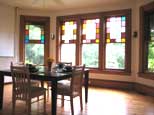
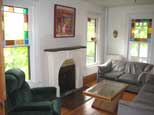
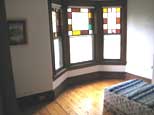
The rooms totally range in size. You should visit to get an idea. Most have high ceilings. There is room for storage in the basement and in an outside shed.
ARE PEOPLE WHO LIVE THERE EXPECTED TO LIVE OR EAT A CERTAIN WAY?
The answer is basically no, though there are a few expectations of all residents. The most important of these is that all residents show a commitment to ongoing learning and growing as it relates to helping create a better world.
Some people may feel strongly about certain issues and ways of doing things. They may have to accept that not everyone in the co-op is going to feel the same way, and perhaps never will. But they can expect that other people in the co-op will try to learn from them and understand their views, if not embrace them.
This allows us to honor the fact that nobody has all the answers, all of us have plenty of shortcomings, and we each have a different path to walk. And it gives us the best chance to learn from others who may be doing fabulous work in areas that we ourselves don’t know so much about. And in the process they may learn a lot from us as well.
 WHO DECIDES WHO WILL LIVE THERE?
The current residents -- by consensus. Common Fire's co-founders, who live at the first Common Fire co-op in Tivoli, will be part of selected the first three residents who will then go on to choose th rest of the residents by themselves (with each resident being part of deciding on everyone selected after them).
WHAT WOULD MY RESPONSIBILITIES BE? HOW MUCH TIME WOULD IT TAKE?
We have weekly meetings that everyone is expected to attend that give us a chance to go deeper in getting to know each other and hear about what each of us is doing and experiencing in our lives. We also use that time to take care of business and address any issues that have come up. That weekly meeting, including having dinner together, usually runs from 6:30-10. So that's 3.5 hours.
We share responsibility for cleaning, shopping, etc., which takes about an hour.
That brings the weekly total to about 4.5 hours.
Sunday through Thursday we rotate in pairs who is responsible for cooking dinner. (That means we each cook dinner once a week and it's prepared for us by others four nights each week.) While co-opers often end up sitting down and eating together, we are only expected to all eat with each other once a week on meeting night.
 The chores can take about an hour, and the cooking and clean-up can take from 2-3 hours. So that brings the weekly total to about 7 hours.
Plus each month a different resident offers an activity related to a topic that's important to them. It can be bringing in a speaker, showing a movie, leading a discussion or a workshop, going somewhere, etc. Everyone is expected to participate if they can. So that's an additional 3 hours or so each month.
That’s basically it. For about 30 hours a month, residents enjoy five homecooked dinners each week, a happy, clean home, and an engaging series of inspiring and educational activities!
WHO OWNS THE CO-OP?
A non-profit organization called the Common Fire Foundation owns the land and the building. This means nobody is making a profit and the house will always be maintained as a home for people striving to improve their communities and the world.
 HOW ARE DECISIONS MADE?
We make decisions by consensus. This means all of us must come to agreement before something is decided. It doesn’t mean that what’s decided is exactly what each of us would choose independently. Consensus means all of us get the chance to share our perspectives so the group can come to a decision that works best for everyone. Any one of us can block a decision if we feel we haven’t been understood or if we are fundamentally opposed. Or we can decide to support a decision we don't fully agree with if we feel we have been heard and the others simply believe the proposal being considered is the best way to go.
The Common Fire Foundation has the final say on matters related long-term viability and mission of the co-op. That means it has the final say on matters related to overall finances, legal issues, the integrity of the building and the land, and anything that might funadamentally shift the purpose of the co-op.
ARE CHILDREN ALLOWED?
Children are welcome. Parents must consider whether one room is adequate or whether they will need 2 or more.
CAN THE CO-OP ACCOMODATE HANDICAPPED PEOPLE?
Sorry, this building was built in 1890 and is not very handicapped friendly. We hope to put a ramp in the front of the house to make it easier for handicapped folks to visit, but all of the bedrooms are upstairs and the half bath downstairs is small.
 ARE PETS ALLOWED?
Pets are not allowed, primarily because it would prevent so many people with allergies from living there or visiting.
HOW MUCH PRIVACY DO PEOPLE HAVE?
It's up to each person to decide how social they want to be. The common area, sining room and kitchen provide lots of space that is often available if someone wants a quiet work/study space. And we always have the privacy of our own rooms. Quiet hours are up to the residents, but currently we ask that everone be quiet from 11pm to 8am.
HOW IS THE GUEST ROOM USED?
Mostly for personal guests of the residents, though we also often make it available as a free place for people to stay who are visiting the area and doing important social or environmental work in the world, or sometimes termporary internships in the local area.
 WHAT KIND OF BUILDING IS IT?
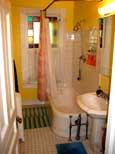
The building is extremely environmentally responsible. In fact, it’s getting a lot of media attention because it’s being certified as the one of the “Greenest Buildings in the US.” It is very efficient with water and energy, and uses safe, nontoxic and sustainable materials.
IS THIS SOME KIND OF RELIGIOUS GROUP?
No. We welcome people of all faiths or no faith.
WHEN ARE APPLICATIONS DUE? WHAT IS THE APPLICATION PROCESS LIKE?
People can apply at any time. We like to start by talking with people over the phone to answer any initial questions and get to know folks a little better. From there the process is a mix of meeting with co-op residents, visiting the co-op, perhaps joining us for a meal or two, and filling out the written application (which we invite you to look at if you'd like, but you should not fill out until you're asked to, just in the interest of saving you time if you or we decide it's not a good fit before that point). Based on all of those interactions and the application we come to a final decision.
BEHIND THE SCENES QUESTIONS
How, and where, did you seek out funding for the co-op?
It wasn't easy as our project doesn't exactly fit in the normal check boxes. We're a housing co-op, owned by a non-profit, converted to be a model green building, and on top of that it was a renovation of a historic building which seems risky to some banks because you sometimes end up discovering thigns you didn't want to know about the house when you open it up.
That said, about 40% of the project cost was covered by a loan from a local bank, Ulster Savings, who we are very grateful to because we went to five other institutions (banks and credit unions) that never could wrap their heads around what we were doing.
The Cooperative Fund of New England, a non-profit that provides loans to cooperative ventures and was a major partner in our first co-op, provided about 24% of the project cost. It was critical that we were able to apply the existing co-op as collateral. (The existing co-op was appraised at $940,000 but the mortgages against it are only about $580,000, meaning there is a lot of value we could borrow against.)
There are three other key pieces to the puzzle.
The New York State Energy Research and Development Authority. Through the New Construction program they provided about $20,000 toward energy efficiency and "green" features of the building, as well as an incentive to pay for our designer/architect and matching funds toward the building modeling and commissioning. And through the Loan Fund we got an interest rate reduction on about $100,000 of our Ulster Savings loan. Specifically the Loan Fund bought down our interest rate by 4% for the first ten years of the loan.
Sponsorships. We benefited tremendously from donations and discounts on products and labor from people who supported our vision. And we reserved 10 official "sponsorships" for companies that stepped up and made significant donations (multiple thousands of dollars or more) in exchange for heightened attention on our website, in news releases, etc.
Donations. We received about $15,000 in individual donations for the project.
The residents' monthly costs include the mortgage payment.
How did you assemble the requisite contractors and builders to attain a "green" building?
The most critical step was finding the right initial partners. Once they were in place everything else came relatively easily. We started with Sean Ritchey of Deep Green Building, a young and super competent man committed to green building, as our general contractor, and Chuck Silver of Hudson River Design. Chuck is super knowledgeable and deeply experienced in green building, including he was the designer on our first co-op. They both worked either pro bono or at extremely reduced cost based on our mission and our track record.
Certainly we at Common Fire did a lot of research ourselves, but with the right people on board in these key positions we were always able to identify and connect with the other necessary people/companies we needed along the way.
What was the timeline between the original conception of the idea for building and completion of the building?
We had been wanting to start another co-op since before we even finished the first one. We needed some time to recover from that, but after about a year and a half since the opening of that co-op a member of the original co-op (the same Sean Ritchey who led construction on this project), found a house that would be perfect for our second co-op. We found the house in November, bought the house in June, and are opening in the fall. So about one year.
IF YOU WOULD LIKE TO LEARN MORE...
or you'd like to visit the co-op, or meet the people already living there, or if you want to apply to live in the co-op, please give us a call or write:
Kavitha and Jeff
(845) 750-6476
info@commonfire.org